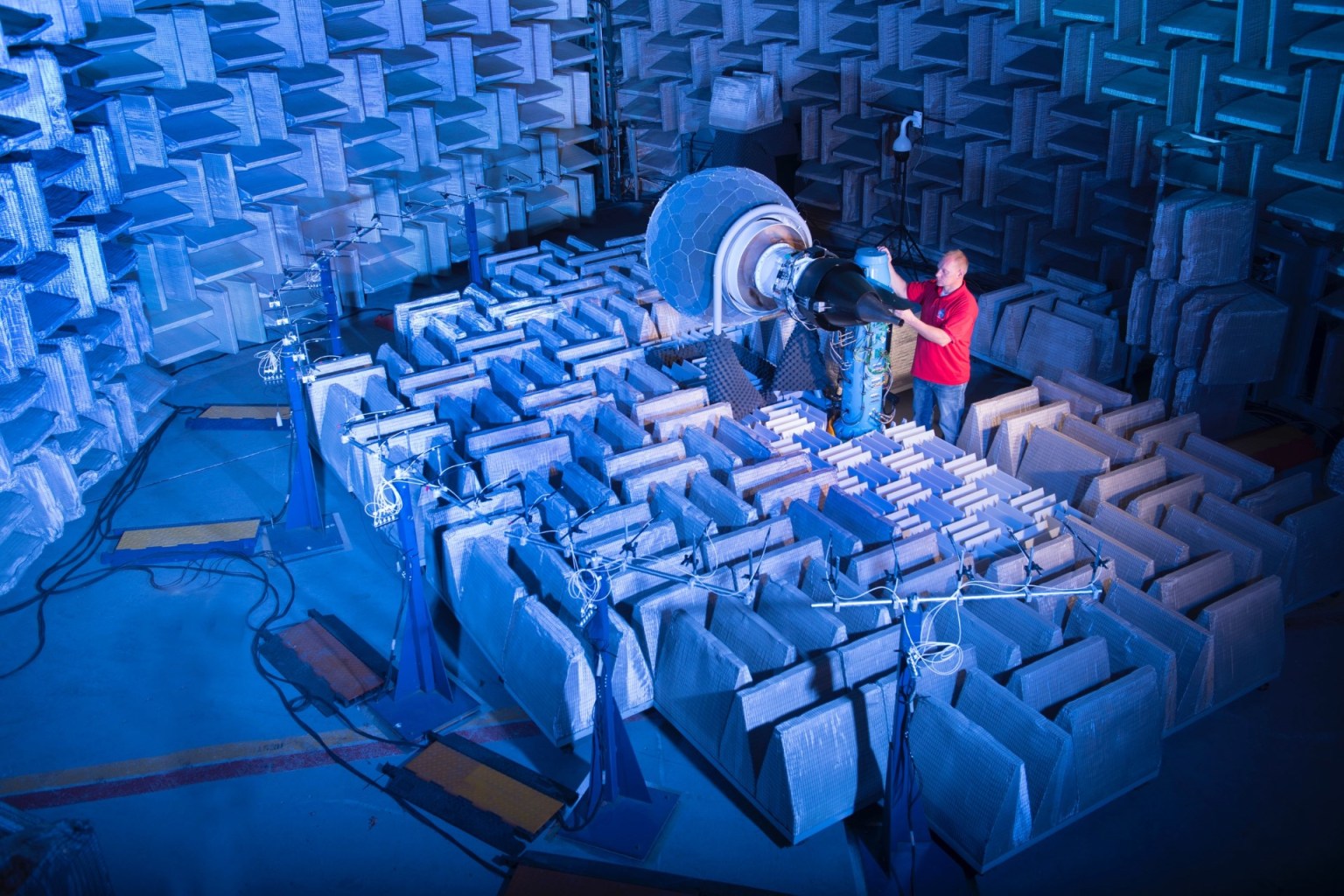
The NASA Glenn Research Center has expanded its experimental facilities to better study and mitigate aircraft engine noise, with key upgrades and new tools supporting research into quieter propulsion systems. Research teams at the center use world-class facilities such as the 9-by-15-Foot Low-Speed Wind Tunnel (9 x 15 LSWT), the Aero-Acoustic Propulsion Laboratory (AAPL), the Small Hot Jet Acoustic Rig (SHJAR), the Nozzle Acoustic Test Rig (NATR), and the DGEN AeroPropulsion Research Turbofan (DART) to advance noise reduction technologies.
The 9 x 15 LSWT, a 9-by-15-foot wind tunnel, was specially designed to provide researchers with a controlled environment to study aircraft engine aerodynamics and acoustics under takeoff and landing conditions. Major modifications completed in 2019 improved airflow and reduced background noise, enhancing the tunnel’s ability to measure sound produced by experimental propulsors. A new 5-sensor traversing microphone rake now helps researchers capture detailed acoustic data.
The Aero-Acoustic Propulsion Laboratory (AAPL), a 65-foot radius geodesic dome, is used to reduce community noise and conduct aeroacoustic tests of aircraft engines and components. The dome’s interior is lined with 17,000 custom-designed 2-ft thick fiberglass wedges that absorb sound and prevent reflections, creating an anechoic environment. Since its construction in 1993, the AAPL has been a key facility for testing advanced propulsion systems, including the Nozzle Acoustic Test Rig (NATR), Small Hot Jet Acoustic Rig (SHJAR), and the DGEN 380 Aeropropulsion Research Turbofan (DART).
The Small Hot Jet Acoustic Rig (SHJAR) is one of three rigs installed in the AAPL’s anechoic dome. It is used to test single-stream nozzles up to 5 cm in diameter at Mach 2.0 and 800 K. Researchers have used SHJAR to develop advanced diagnostic techniques such as Rayleigh Scattering, Raman Scattering, digital Schleiren, and real-time Particle Image Velocimetry. These techniques help unlock the mysteries of how turbulence caused by nozzles creates noise, with recent advancements including time-resolved measurements of turbulent temperature using Raman-based optical methods.
The Nozzle Acoustic Test Rig (NATR), a free-jet wind tunnel, plays a critical role in evaluating jet noise reduction concepts. It can simulate takeoff and landing conditions up to Mach 0.35 and supports testing of scale models of nozzles from both military and commercial aircraft engines. The NATR’s arc of overhead microphones measures far-field noise at all angles, enabling accurate translation of measurements to real-world aircraft scenarios. Over its 30-year history, the NATR has been the origin of many important jet noise breakthroughs, including the discovery of chevron nozzles in 1997.
The DGEN 380 Aeropropulsion Research Turbofan (DART) is the primary component integrated into NASA Glenn’s DGEN Aero-propulsion Research Turbofan. It serves as a flexible test bed for aeroacoustic and aero-performance studies, providing valuable data for NASA’s technology maturation process. Recent tests completed in August 2019 focused on propulsion-noise sources to improve turbofan noise-prediction methods and noise-mitigation techniques, with simultaneous acoustic measurements using circumferential and farfield microphone arrays.