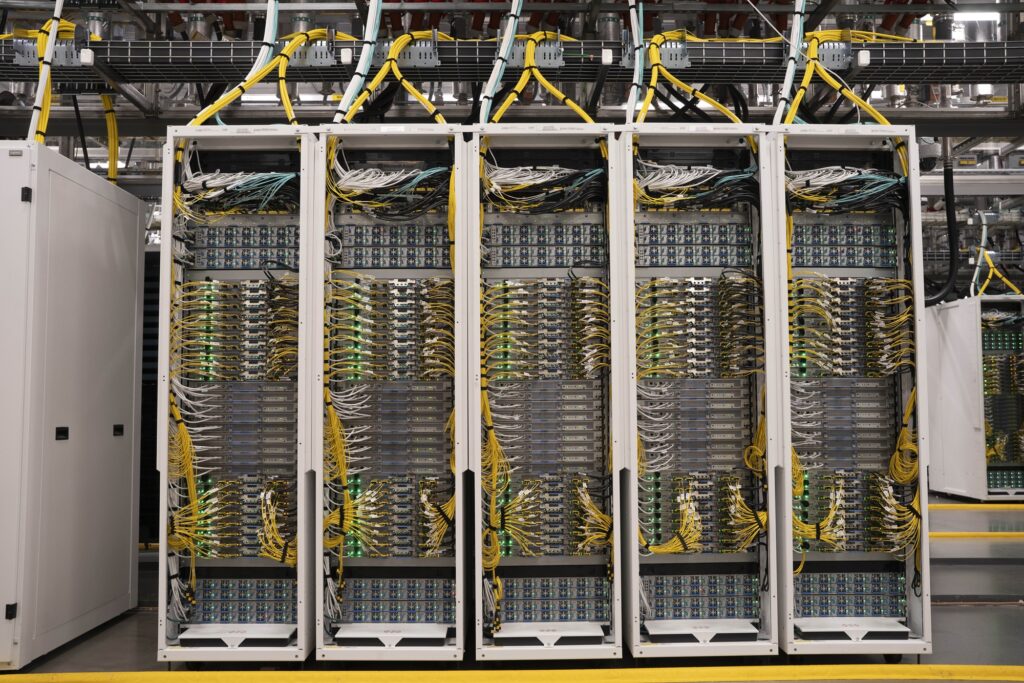
Microsoft announced that its Atlanta Fairwater datacentre had begun operating as part of a network designed for large AI workloads. In its November feature, the company described dedicated links between sites. The facilities combine dense GPU racks, liquid cooling and networking intended to coordinate computing across locations.
The company said the architecture could let multiple sites support one training job instead of treating each building as a separate system. It also described further locations under construction and plans to connect them through fibre. These are Microsoft’s descriptions of its infrastructure and intended capabilities, rather than an independent benchmark of every performance or efficiency claim. Atlanta’s reported operation is distinct from projects that were still being built.
A network designed for one large computing job
Microsoft describes Fairwater as a change in how it organizes infrastructure for large AI workloads. A conventional cloud facility can run many separate applications for different customers. The company’s new design instead aims to coordinate very large numbers of processors around a demanding training job, including work that spans more than one physical site.
The Atlanta facility began operating in October, the company said in its November announcement. It uses the same architecture as Fairwater Wisconsin. Microsoft says dedicated fibre connections allow the locations to exchange data rapidly and will eventually connect additional sites under construction in the United States. That expansion remains a plan rather than evidence that every proposed facility was operating at publication.
Inside each location, the design brings processors close together and connects them through high-throughput networking. Microsoft describes a two-storey layout intended to increase computing density while limiting communication delays. The arrangement also requires engineering for the weight of equipment, cable routes and cooling pipes; the company presents these as parts of an integrated infrastructure design.
Connections between distant locations matter because training involves exchanging intermediate calculations. If one part of that process stalls, other processors can spend time waiting rather than computing. Microsoft says its dedicated network and communication software are intended to reduce those bottlenecks. The announcement’s performance comparisons are company claims, rather than independently measured results presented by this publication.
The company also describes a closed-loop liquid cooling system for the Atlanta site. Water circulates through the equipment and cooling infrastructure rather than being continually replenished as part of normal operation; replacement depends on water chemistry. The article links those engineering choices to the challenge of cooling dense AI hardware, without establishing that the facility has no environmental impact.
Fairwater is presented as infrastructure for training and using AI systems, including workloads associated with Microsoft and OpenAI. The practical significance of the announcement is the attempt to make geographically separated computing resources cooperate as a single system. Its eventual capacity and efficiency will depend on the facilities and networks actually brought into service.